Customer journey is quite simply a map of every stage the consumer goes through when dealing with your brand or business. These are referred to as “touchpoints” every instance your brand or business has any interaction with the consumer. Including both online and offline, every exposure to the brand must be included to give an accurate picture of your strengths and weaknesses.
Depending on your business model and focus you can monitor every stage for years (if you are a premium or service brand) or if it’s an FMCG it could just be a few weeks. It can be completely tailored to you and your business. An added bonus, it’s completely free to do yourself!
Where did it come from?
This concept was first pioneered by Ron Zemke and Chip Bell in the 1980’s but is detailed in their joint work Service Magic. (2003) By putting yourself in the consumer’s shoes you can analyse your business at a different level which in the long term will be extremely beneficial and encourages consumer loyalty. Every single touchpoint must convey the same brand experience as the product itself.
The key stages are listed below with ideas of how to begin thinking about touchpoints in each category. (These are just ideas the categories themselves may change in your customer journey.)
Awareness – Consumer first introduction to your brand.
Consideration – Consumer may compare you with competitors or evaluate your brand individually.
Purchase – The instore or checkout experience online.
Service – This can be an actual service or delivery or how they were treated overall.
Loyalty – Engaging actively with your brand whether it’s online or repeat custom.
How can I use it?

Here you can see a basic outline of a customer journey map, there are more examples online just search until you find one that you are comfortable with! It also comes with handy examples of touchpoints that you can think about implementing or give you inspiration for a stage that may be weaker with fewer touchpoints.
Here is my example:
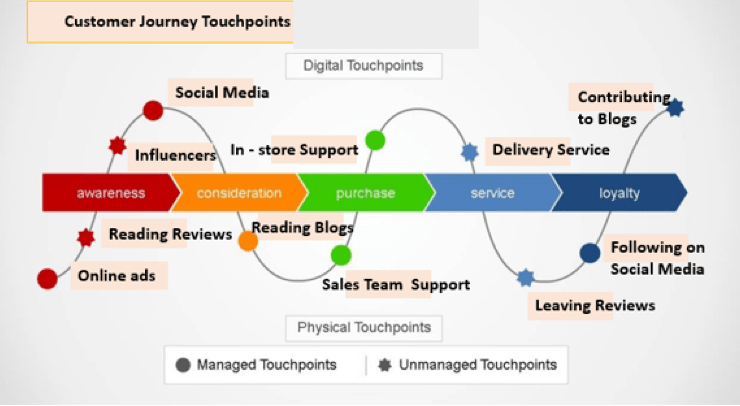
You can edit each box in order to really understand the buying process which can help you evaluate where you need more or less effort and focus.
When referring to ‘managed’ it simply means the organisation controls the content or experience the customer has.
The ‘unmanaged’ means the organisation has little to no control over the experience or content. Of course in an ideal scenario the business would have control over every touchpoint but that is simply impossible in the modern age.
Instead you should focus on having as many touchpoints as you can with each offering a high standard of service that represents you and your brand. Remember it is a reflection of your brand and negative influences may result in profit loss or loss of consumers.
If you are still struggling to analyse your customer journey, you should place your USP as the focus and determine whether or not the stages represent and manifest your brand identity in a positive way.
If the service and support are lacking with consumer expectations you could be leaving consumers with a negative experience. This can be extremely damaging to a brand leading to negative reviews and complaints on social media and beyond.
Each business has a unique customer journey, therefore the strategies have to be unique and tailored to your business. The purpose of a consumer journey is to allow the business the opportunity to see the consumer perspective which can often be overlooked, the benefits of a strong consumer journey can’t be understated with many consumers first exposure to a brand being the most important and leaving a lasting memory.
What do think about consumer journey? Have you developed one for your business/brand?
Please leave a comment below!
 Marketing Explained